
Bridging Genomics and Agriculture: Key Takeaways from AGBT-Ag 2026
Advances in Genome Biology and Technology (AGBT) hosted its Agricultural meeting April 12-15, 2026 in Phoenix, Arizona. AGBT-Ag brought together leading genome researchers, data scientists, breeders, policy makers, funders and innovators, focusing on the integration of genomics and agriculture in an effort to help address the escalating needs of a changing earth. Leading scientists and researchers presented many exhibits, workshops and posters over the course of the 4 day meeting.
Representing the AgBioData NLP4Biocuration working group, Kapeel Chougule from the Ware Lab at Cold Spring Harbor Laboratory, presented a poster and flash talk titled “NLP4Biocuration: Advancing FAIR, AI-Assisted Literature Curation Across the AgBioData Consortium.” His presentation highlighted the consortium's collaborative efforts to address the critical challenge of scaling literature curation for 45 genetic, genomics, and breeding databases, where the rapid growth of scientific publications has significantly exceeded manual review capacity. He detailed a community-driven six-stage framework for AI-assisted biocuration, evaluating the integration of natural language processing and large language models like BioBERT and OntoGPT to automate literature triage and entity extraction. Then , he demonstrated a successful proof-of-concept using a local, Dockerized Textpresso pipeline to index and search sorghum-specific literature, providing a scalable pathway for advancing FAIR data standards across agricultural genomics resources.
Other plenary speakers included Rob Martienssen (Cold Spring Harbor Laboratory), who showcased the rapid growth and nutritional potential of duckweed (Lemnaceae) as a sustainable protein and oil crop, and Joshua Stein (International Wheat Genome Sequencing Consortium), who presented the IWGSC Wheat Diversity Project’s progress in sequencing 12 selected landraces to recover diversity lost through domestication. Alyx Shigenaga (UC Davis) shared innovative strategies for engineering rice immune receptors to combat fungal pathogens, while Krishna Niyogi (UC Berkeley) and Gloria Coruzzi (NYU) discussed optimizing photoprotection and using AI-inspired models to improve nitrogen and water use efficiency in maize and rice. Julie Gray (University of Sheffield) highlighted how manipulating stomatal density can enhance climate resilience in wheat and rice, and Leif Andersson (Uppsala University) explored the Atlantic herring as a keystone species for understanding genetic adaptation.
Highlights of this symposium included deep dives into the transition from single-reference genomes to complex pangenome graphs, emphasizing tools like vg toolkit, PanKmer, Panagram and GRASP to mitigate reference bias and enable structural variant discovery. The meeting also underscored the integration of machine learning and directed evolution to accelerate breeding for stress-resistant varieties, alongside community-wide efforts to standardize FAIR data practices across the AgBioData consortium. Participants also gained insights into the regulatory and intellectual property landscapes through the "Seeds of Innovation" panel, rounding out a program dedicated to bridging the gap between basic genomic research and field-ready agricultural solutions.
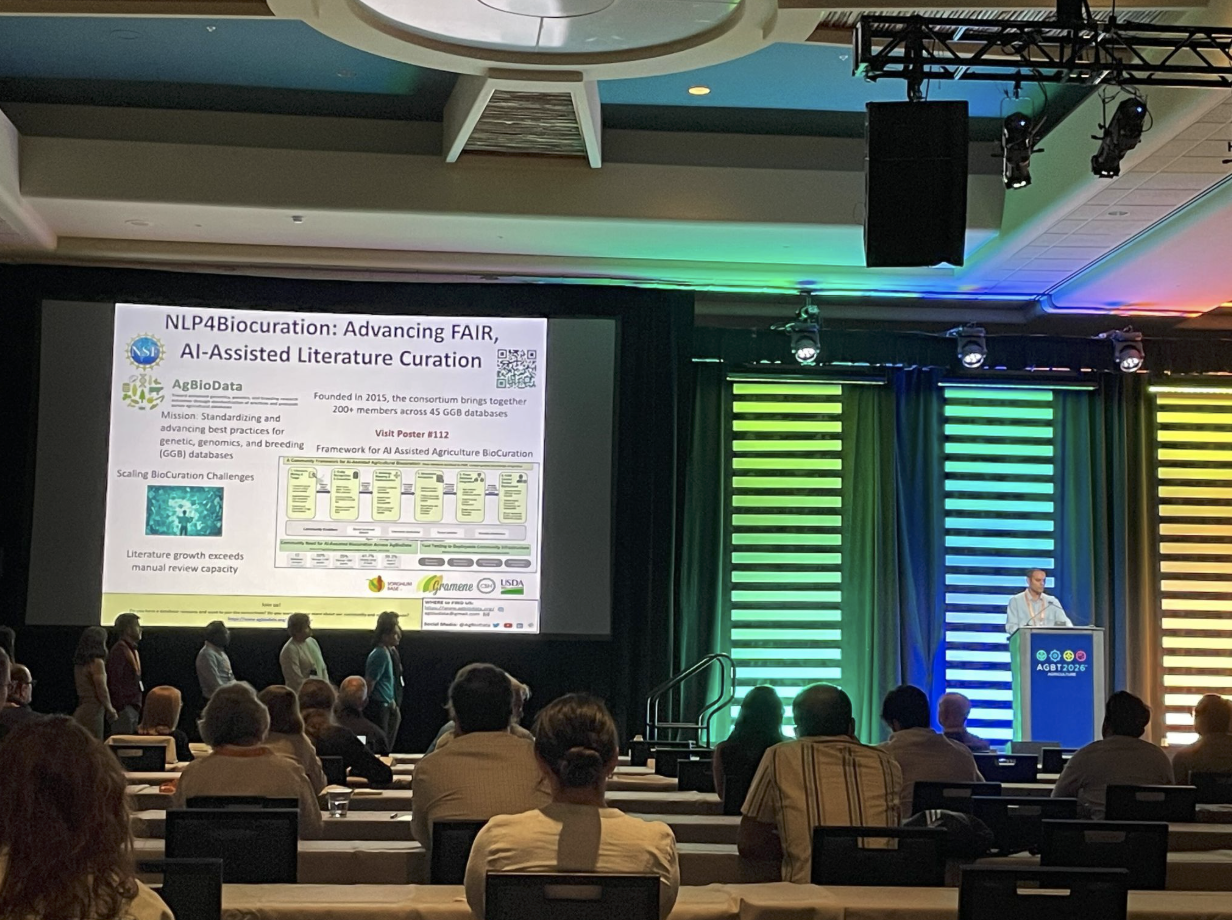
Kapeel Chougule presenting a selected poster as part of a flash talk, focusing on AgBioData and highlighting the importance of scaling biocuration for databases using AI assistance. Photo credit: Dario Coppetti
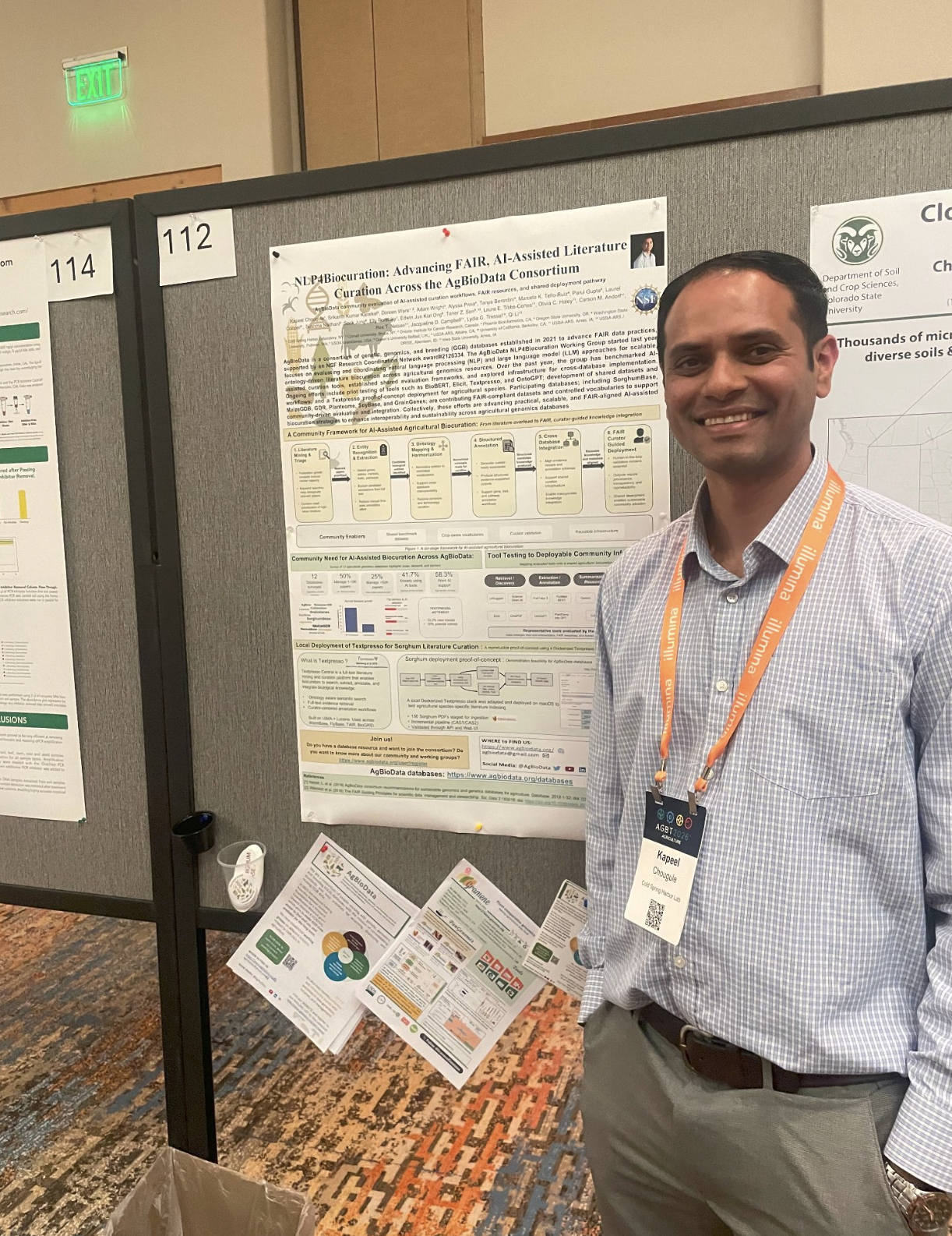
Kapeel Chougule presenting at poster session. Photo credit: Dario Coppetti
- aolson's blog
- Log in to post comments